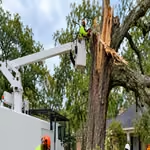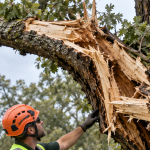
A leaning tree becomes an emergency in Jackson, MS, when it shows signs of structural failure and poses an immediate risk to people, homes, or utilities. Sudden changes in lean, exposed roots, trunk cracks, or soil lifting indicate root failure and imminent collapse. These conditions require urgent professional assessment to prevent property damage, injury, or loss.
Key Takeaways
- A sudden change in a tree’s lean, root uplift, or significant trunk cracks are critical signs of an emergency.
- Homeowners in Jackson, MS, often need a Certificate of Appropriateness (COA) for tree removal, even in emergencies, to avoid fines.
- DIY removal of a leaning tree is extremely dangerous and can lead to severe injury, property damage, and increased liability.
- Insurance typically covers tree removal only if the tree damages a ‘covered structure’; check your policy specifics.
- Hiring a reputable, insured arborist, such as Heritage Tree Services, is essential for safe and compliant emergency tree removal.
Spotting the Red Flags: When a Leaning Tree Needs Immediate Attention
Not all leaning trees are emergencies. Many trees develop a lean over time, adapting to sunlight or prevailing winds, and remain perfectly stable for decades. The key is recognizing the difference between a stable lean and one that indicates a structural failure in progress. It’s often the sudden changes or the presence of other distress signals that mark a true emergency.
Sudden Change in Lean
This is perhaps the most obvious and alarming sign. If you notice a tree that has suddenly shifted its angle, especially after a storm, heavy rain, or ground saturation, it’s a major red flag. This often indicates a root system that’s failing or has already failed. You might see the ground around the base of the tree heaving or cracking.
Visible Root Uplift or Soil Heaving
In our experience on-site, one of the clearest indicators of imminent failure is root uplift. If you see soil mounding up on the opposite side of the lean, or if roots are visibly tearing and lifting out of the ground, the tree’s anchoring system is compromised. This is a tell-tale sign that the tree’s structural integrity is failing, and it could topple at any moment. Don’t delay in calling for help.
Trunk Cracks, Splits, or Deep Cavities
Cracks or splits in the trunk, especially near the base or where major limbs attach, are serious. These can be signs of internal decay or structural weakness. Look for vertical cracks, deep splits, or large cavities that could compromise the tree’s ability to stand upright.
Signs of Poor Health or Decay
A tree that has lost a significant portion of its leaves, has discolored foliage, or exhibits excessive dead branches could be suffering from disease, pest infestation, or severe stress. While not always an immediate emergency on its own, a weakened tree is far more susceptible to failure, especially if it’s also leaning.
Proximity to Structures or Power Lines
Trees that are leaning heavily towards a house, garage, power lines, or frequently used pathways pose an inherently higher risk. Even a stable lean can become an emergency if a storm further weakens it, turning a potential fall into a direct threat to property or life.
Jackson, MS Tree Regulations and Emergency Permits
Dealing with a leaning tree in Jackson isn’t just about the tree; it’s also about understanding local rules. The City of Jackson has regulations in place to manage urban trees, and failing to follow them can lead to fines, even in emergencies.
Understanding Jackson’s Permit Requirements
For many tree removals in Jackson, especially for large trees or those within historic districts, you’ll need a Certificate of Appropriateness (COA) from the City of Jackson Urban Forestry Division. One common thing we see in the field is homeowners, panicked by a leaning tree, rushing to remove it without checking for permits. This can lead to unexpected fines. While true emergencies often allow for faster processing or even post-removal notification, it’s always best practice to contact the City’s Urban Forestry Division or have your arborist do so immediately. They can advise on the specific steps for emergencies to ensure compliance.
Homeowner Responsibility vs. City Services
The City’s Public Works Department assesses trees that might pose a danger to public spaces, but addressing trees on private property is generally the homeowner’s responsibility. Property owners must be proactive. The Mississippi Forestry Commission also provides valuable resources on tree health and management across the state.
Costs, Insurance, and Avoiding DIY Disasters
When a tree is leaning dangerously, the first thought for many is cost. Emergency services are almost always more expensive than planned removals, and it’s vital to understand what your financial obligations might be. The cost reflects the increased risk, specialized equipment, and rapid response required.
| Factor | DIY Leaning Tree Removal | Professional Leaning Tree Removal |
| Safety Risk | Extremely High (Risk of severe injury, electrocution, and property damage) | Low (Trained crew, insured, specialized equipment like bucket trucks) |
| Equipment | Chainsaw, ladder, ropes (Often inadequate for heavy leans) | Cranes, advanced rigging, heavy-duty chippers, PPE |
| Expertise | Limited (Risk of improper cuts causing unpredictable falls) | Professional Arborists (Understand tree physics and safe felling vectors) |
| Liability | None (Homeowner is fully personally liable for accidents) | General Liability & Workers’ Comp (Protects the homeowner) |
| Total Cost | Initial savings, but high risk of massive secondary costs (medical/repair) | Higher upfront fee, but creates a cap on financial risk |
Navigating Insurance Coverage for Leaning Trees
This is a common point of confusion. Most homeowners’ insurance policies in Mississippi only cover tree removal if the tree falls and damages a covered structure, like your house, garage, or fence. If a leaning tree falls without hitting anything, or if it’s deemed a preventable hazard that you neglected, the cost of removal is typically out-of-pocket. Always review your policy and speak with your insurance agent to understand your coverage.
The Dangers of DIY Tree Removal
In our years of experience, we’ve seen the serious consequences of homeowners trying to tackle a leaning tree themselves. Attempting to remove a large or precariously leaning tree is incredibly dangerous. It can lead to severe injury, additional property damage, or even electrocution if power lines are involved. Professionals have the specialized training, heavy equipment (like cranes and bucket trucks), and critical insurance coverage to perform these jobs safely. Don’t risk your life or property to save a few dollars; the potential costs are far too high.
Frequently Asked Questions
How can I tell if a leaning tree is an emergency in Jackson, MS?
A leaning tree is considered an emergency in Jackson, MS, if it shows sudden changes in its lean, has visible root uplift, significant trunk cracks, or is near power lines or structures, posing an immediate threat. If you’re unsure, it’s always best to have a Professional arborist perform a risk assessment.
Do I need a permit for emergency tree removal in Jackson, MS?
Yes, for many tree removals in Jackson, especially large trees or those in historic districts, you’ll need a Certificate of Appropriateness (COA) from the City of Jackson Urban Forestry Division. Even in emergencies, contacting them or having your arborist do so is crucial to avoid fines.
Will my homeowners’ insurance cover the cost of removing a leaning tree that hasn’t fallen yet?
Typically, homeowners’ insurance in Mississippi will cover tree removal costs if the tree falls and damages a ‘covered structure’ like your house, garage, or fence. If the tree falls without hitting anything, or if it’s deemed a preventable hazard you ignored, removal might be an out-of-pocket expense. Always check your specific policy.
What’s the average cost for emergency leaning tree removal in Jackson, MS?
Emergency tree removal in Jackson, MS, can range from $700 to several thousand dollars, depending on the tree’s size, location, and the complexity of the removal. Factors like proximity to structures or power lines, and the need for specialized equipment like cranes, significantly increase costs.
What should I do immediately if I notice a tree leaning dangerously on my property?
If you suspect your tree is leaning dangerously, contact a Professional arborist immediately for a professional assessment. Avoid attempting to fix it yourself, especially if it’s large or near power lines. Keep people and pets away from the area until professionals arrive.